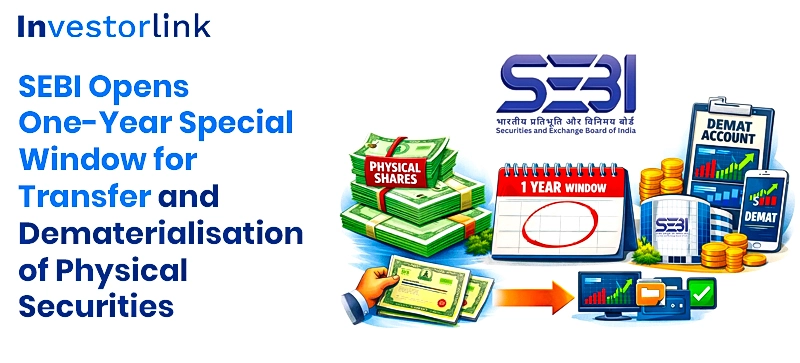
Many investors in India hold shares and other securities in the form of paper certificates. These were standard systems, but the rules have changed over time. SEBI made demat mandatory for share transfer from April 1, 2019. So, many old investors faced problems.
SEBI has taken an important step to eliminate this problem. A special window for transfer and demat of shares for one year (February 2026- 2027) has been opened. It aims to protect the interests of investors and make the investment process easier.
In many cases, paper shares could not be transferred due to incomplete documents, or the application was stuck for years. So, the investors did not get full access to their holdings. But wait, so how can this one-year window for dematerialisation of physical shares resolve this? Read the blog to learn more.
Understanding Physical Securities and Demat Obligation
Physical securities refer to paper certificates of shares or bonds, proving ownership of an investor in a company. Earlier, investors used to keep these certificates in their possessions. All the buying and transferring of shares was done through paper. But physical shares were more prone to getting misplaced, theft, and damage.
Now, these physical securities are kept in the depository account in electronic form in the demat system. This reduces the risk of losing shares and speeds up transactions.
What is SEBI’s One-year Special Window?
On January 30, 2026, under the Circular No. HO/38/13/11(2)2026-MIRSD-POD/ I/3750/2026, for Ease of doing business: Special Window for transfer and dematerialisation of physical securities, SEBI announced a special one-year opportunity opened from February 5, 2026, to February 4, 2027, for the transfer and demat of physical securities.
This facility applies to those shares or securities that were bought or sold before April 1, 2019. Investors who could not complete the transfer for any reason will get this opportunity. The decision is a continuation of a previous circular of SEBI dated July 2, 2025. This resolves old and pending cases so that investors finally get full rights to the securities.
Who is Eligible under SEBI’s Special Window?
SEBI’s special window for transfer and dematerialisation of physical securities is not for everyone. SEBI has clearly laid down some conditions so that only genuine investors get the benefits.
Eligibility under the special window:
- Investors who still have the original physical share certificate.
- Shares for which the transfer deed was completed before April 1, 2019.
- Applications that were submitted earlier but were rejected, returned, or not processed.
- In cases where the required original documents are still available.
The presence of the original certificate is the most important condition here. The application will not be accepted without it. If necessary, individual investors as well as legal heirs can also apply through a specific process.
Cases Covered and Not Covered Under the SEBI Scheme
SEBI’s special window addresses the problems faced by genuine and old investors. It has identified certain cases as eligible and clearly excluded some cases. Here is a given table for your understanding. This helps investors determine whether their application falls under this scheme or not.
| Eligible Cases | Cases Not Considered |
| Physical securities bought or sold before April 1, 2019 | Securities have been already transferred to the IEPF. |
| Transfer requests that were rejected or not processed earlier | Disputed cases between the transferor and transferee. |
| Original share certificates are available | Cases where original certificates are missing. |
| Valid transfer deeds executed before the cut-off date | Matters pending before courts or NCLT. |
In the view of the above structured table, investors can quickly decide whether their case is eligible or not before applying.
Explanation of Mandatory Demat and One-Year Lock-in Rules
While SEBI has allowed transfers through this special window, there are some crucial conditions too. All securities will be deposited in the investor’s account only in demat form.
In addition, there will be a mandatory lock-in for one year from the date of transfer registration. During this period:
- Shares or securities cannot be transferred.
- No pledge or lien of any kind can be given.
- Securities cannot be encumbered in any way.
This rule prevents abuse and maintains transparency in the market. Also, it reduces the risk of sudden transactions and increases confidence in the investment system.
Documents Required to Apply under the Special Window
Investors must submit the correct documents to avail the benefits of the SEBI’s special window scheme. Even a slight mistake or omission in the documents can lead to rejection of the application. So, it is better to have all the papers ready from the beginning.
Documents required at the time of application:
- Original physical share certificate, which is proof of ownership.
- Transfer deed executed before 1st April 2019.
- Proof of share purchase, if available.
- Applicable KYC documents.
- Latest Client Master List (CML), not more than two months old.
- Undertaking-cum-indemnity in the prescribed format.
The Depository Participant must attest to these documents. The more accurate and complete the documents, the easier it will be.
Role of RTA, Stock Exchange and Listed Company
There are multiple agencies responsible for implementing SEBI’s special window. It has clearly defined the roles of RTA, the stock exchange, and the listed company.
- Registrars and Transfer Agents (RTAs) will verify and process the applications.
- SEBI has directed that there should be no unnecessary delays.
- Listed companies will assist in verifying share information.
- Stock exchanges handle the system and the coordination work.
- Investors will be assisted in resolving queries or complaints.
This integrated system will make the entire process more transparent and investor-friendly.
What SEBI’s Letter of Confirmation (LOC) Rules haveChanged?
SEBI has introduced the Letter of Confirmation (LOC) for many demat-related services. In this letter, the investor was informed that a share was approved for demat. However, this system became time-consuming. There was a delay in the entire process of sending, receiving, and submitting the letter. In many cases, there was also a risk that the letter would get lost.
SEBI has now done away with the LOC system to resolve this problem. Under the new rules, after necessary verification, the RTA or the company will directly credit the shares to the investor’s demat account.
The change applies to the services:
- Issue of duplicate share certificates.
- Transmission (transfer in case of death).
- Transposition.
- Various corporate actions.
This will reduce time and risk to a great extent.
Effective Dates and Transition Provisions Explained
Separate effective dates have been fixed for these new SEBI measures. See below:
A special one-year window will be effective from February 5, 2026, until February 4, 2027. Investors will be able to apply from that day onwards.
The new rules regarding LOC will come into effect from April 2, 2026. However, the LOCs issued earlier will not be cancelled.
Dematting can be done using this LOC if it is submitted within 120 days from the date of issue. This transition rule will give additional time and convenience to investors.
Why is SEBI’s One-Year Window Decision a Big Relief for Investors?
SEBI will provide a solution to a long-standing problem for many investors. Many shares were stuck for years, which could not be used. Now investors can regularise their physical securities to easily obtain access to their holdings.
Through this system:
- The path of old and stuck investments will be opened.
- The ownership rights of the investor will be strengthened.
- Long-standing complaints and frustrations will be reduced.
- The acceptability of the demat system will increase.
- The confidence of the public in the capital market will be strengthened.
Overall, this is an important initiative to create an investment-friendly environment.
Final Words
SEBI opening a special one-year window for transfer and demat of shares is a great opportunity for investors. However, it is very important to have the right documents, deadlines, and rules to avail this opportunity. A small mistake or delay can lead to the rejection of the application.
This is where Investorlink experts help investors. We help with eligibility verification, document preparation, the demat and transfer process, and even coordination with the RTA and Depository Participant. A year passes very quickly. It is important to start the necessary preparations now, without delay.
Top Questions Regarding
SEBI’s one-year special window is a time-bound opportunity to transfer and demat the old physical shares. This window will open on February 5, 2026, and close on February 4, 2027. It is mainly for those investors who had bought or sold shares before April 1, 2019, but could not complete the transfer for any reason.
Investors who still have the original physical share certificates can take advantage of this window. The transfer deed of purchase or sale of shares must be completed before April 1, 2019. Even if the earlier application was not rejected or processed, a fresh application can be made with all the necessary documents.
Yes, the earlier transfer application was either rejected or pending for various reasons. SEBI has also brought such cases under a special window. However, the investor must have the original share certificate. The transfer deed must be processed before the prescribed date. If the documents are correct, then a re-application can be made.
The original share certificate is the most important proof of ownership. SEBI accepts those cases where the original certificate is available. It is difficult to verify the validity of the shares without the certificate. This condition has been kept to avoid fraud or false claims. So, if the certificate is lost, the benefit of this window will not be available.
SEBI’s special window requires the following documents:
– The original physical share certificate for the application.
– The transfer deed made before April 1, 2019, applies to KYC documents.
– Submit the latest Client Master List (CML).
– Submit the prescribed undertaking-cum-indemnity.
– Proof of purchase of shares may also be required if necessary.
All documents must be properly attached.
Shares that have already been transferred to the Investor Education and Protection Fund (IEPF) will not be covered under this special window. There are separate rules and procedures for such cases. The investor will have to recover the shares back through the IEPF-specific reclaim process.
Earlier, a Letter of Confirmation (LOC) was required for demat, which was time-consuming. Now SEBI has done away with this rule. In the new system, the RTA or company will deposit the shares directly into the investor’s demat account after verification. This will reduce time, minimize the paperwork, and ensure there will be no risk of losing the letter.
Investorlink helps investors in the entire process. Guidance is provided for eligibility verification, preparation of necessary documents, demat and transfer applications, and coordination with the RTA or Depository Participant. This reduces the risk of mistakes and increases the chances of the application being successful. It is very important to get the right help during this one-year window.