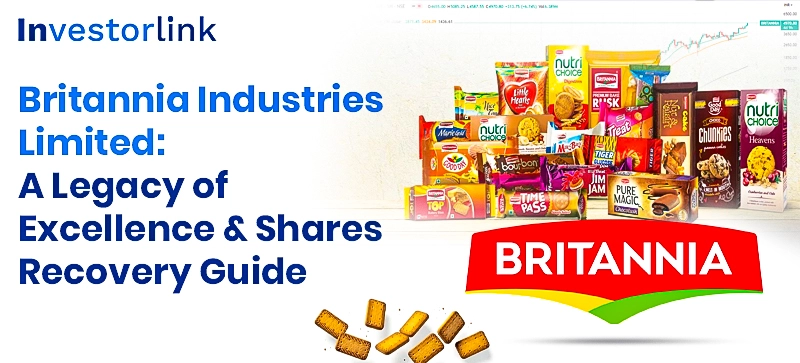
Britannia Industries Limited is a recognised and honourable brand within the Indian business arena. Founded in 1892, Britannia’s journey started from a small biscuit manufacturer in Kolkata to a popular FMCG brand. For more than 134 years, it has produced products while making its strong presence in the hearts of Indian families, as a symbol of breakfast, lunch, and more.
Apart from its appeal to the consumer, Britannia Industries Limited is a fascinating case study for creating shareholder value. The company’s FMCG recognition has made India proud, owing to its innovation and effective management of finances. For an investor, this will mean stable dividends, strong performance in Britannia stocks, and overall wealth creation.
However, with corporate operations such as bonus issues, stock splits, and dividend declarations over many years, many shareholders may inadvertently have forgotten their shares. Unclaimed shares that Britannia investors had once acquired and dividends that they had earned could currently be dormant and waiting to be reclaimed through legal processes.
This blog connects both worlds: comprehending the operational excellence of Britannia Industries Limited and enabling investors to get back what is rightfully theirs by recovery of shares from IEPF.
Britannia Industries Limited: From a Small Kolkata bakery to India’s Biggest FMCG Icon
Know about the most renowned brand, Britannia Industries Limited, starting from its history to its brand impact, and consumer trustworthiness.
Company History and Evaluation
From Britannia’s establishment to its seamless market supply that built strong presence since British duration, and successful milestones.
Britannia Company Setup
The story of Britannia Industries Limited started in 1892. During British India, a small contingent of British businesspeople set up a modest bakery in Kolkata. This marked the beginning of a small biscuit-manufacturing unit, overtime that became one of the most recognizable brands in India’s food industry.
Britannia’s Supply and Production Facility
During its formative years, it supplied biscuits to the British army and went on to gradually build a presence across colonial India. After independence, the company set off on an ambitious expansion agenda, modernizing production facilities, introducing mechanized manufacturing lines, and expanding distribution networks to attain reach and visibility across every niche and corner of the country.
Achieved Milestones of Britannia Brand
Several milestones are dotting this spectacular journey:
- The launch of the popular Britannia Marie in 1939
- Its acquisition by the Wadia Group in the 1990s
- Strategic diversification into milk products during the 2000s.
As of today, over ₹1.5 lakh crore market capitalization for Britannia testifies to a fitting FMCG legacy that is uniquely distinctive of India.
Brand Impact and Product Diversification
Britannia’s product range encompasses so many categories beyond biscuits. Today, the company now has leads in several categories:
- Biscuits: Good Day, Tiger, Bourbon, NutriChoice, 50-50, Marie Gold
- Bread & Bakery: Sandwich bread, rusks, cakes
- Dairy Products: Butter, Yoghurt, Cheese, Milk
- Other Products: Cream rolls, Croissants, Wafers
Through this diversification approach, Britannia’s stock performance has ensured a proper supply of this product as it is not vulnerable to the fluctuating demands of a particular category.
Geographically, Britannia operates in more than 80 countries and has a strong base in the Middle Eastern, African, and North American markets.
Brand Trust and Consumer Loyalty
The significant factor that sets Britannia Industries Limited apart is the trust it has among the generations of Indians. For Indians, Britannia products are associated not just with memories of childhood and festivals but also with the usual routines of life.
This loyalty is due to its uncompromising commitment to quality, price, and continuity. Whether one consumes Good Day biscuits from Delhi or Kochi, one has precisely the same taste experience, and this consistency is a symbol of operational efficiency that strengthens brand image.
Britannia’s Core Business Operations and Market Position
Under this sector, know about the core business operations and market position of the Britannia brand.
Manufacturing Scale and Efficiency
Britannia Industries Limited has one of the most extensive manufacturing facilities in the FMCG sector in India. The company has various manufacturing facilities located across different parts of the country to reduce logistics costs and ensure a smooth supply chain. Advanced automation and lean manufacturing systems result in reduced wastage and enhanced output at competitive prices.
Supply Chain and Cost Management
The supply chain for Britannia is data-driven and embraces procurement, inventory, and distribution. It is cost-disciplined by virtue of the fact that it is a consolidated procurement operation, protected from raw material price volatility as well as exchange risk.
Distribution Network of Britannia
The distribution reach of this company is unmatched, as it reaches millions of retail outlets in India. Distributors and wholesalers benefit from real-time demand forecasting tools that avoid inventory shortages and maximize sales. Since it reaches tier-2 and tier-3 cities, it is accessible to various groups of consumers.
Market Leadership and Competitive Advantages
Operational depth and strategic positioning continue to fuel Britannia’s dominance in the FMCG business. Some key competitive advantages are:
- Supply chain resilience: integrated systems protect margins against volatility.
- Manufacturing depth: multi-plant operations guarantee supply reliability and cost efficiency.
- Operational agility: constant modernization provides ground for adaptability and investor confidence.
- Distribution strength: the nationwide reach creates unmatched consumer access.
Investor Relevance
Combined, these operational pillars help explain the dominance of Britannia in the FMCG sector. Notably, for an investor, it implies stable profits, strong Britannia stock performance, and minimized risk exposure, thereby strengthening its position in the context of a reliable vehicle for creating wealth.
Britannia’s Financial Performance and Share Price Analysis
Discover the ongoing financial performance and analysis of share prices for the most highly recognized brand, Britannia Industries Limited.
Revenue and Profit Growth Trend
Britannia has seen an uninterrupted positive trend in operating revenues. Over the last 5 years, the operating revenue has increased from around ₹131,000 million in FY2021 to over ₹184,000 million in FY2025, registering an appropriate 8-9% of compound annual growth rate (CAGR).
This increase has been supplemented by the rise in volumes, the launch of premium products, and forays into the dairy and adjacent segments. Meanwhile, the net profit has also held its own, supported by efficiency and controlled spending, resulting in uninterrupted dividend payments to its investors.
Margin Performance
The gross margins have been holding up at 38-40% average. This is despite fluctuations in raw material prices like wheat, sugar, and dairy. Britannia’s strength in locking in raw material prices and optimizing supply chains has helped it retain its margins.
The operating margins remain at an average of 15-17%, which is encouraging, given that Britannia performs better than its competitors in the FMCG business.
Share Price Movement over Time
There has been long-term appreciation in the share price of Britannia, symbolizing investor confidence in its fundamentals. Over the 5-year period, the stock has moved from ₹2800-₹3000 to over ₹6,000, symbolizing tremendous value creation.
This has been clearly visible in its resilience during times of falling markets with speedy recoveries on account of good quarterly numbers, as well as on account of dividend declarations.
Market Reaction to Some Key Events
The market has rewarded Britannia’s strategy initiatives:
- Evolution into the dairy segment as well as the premium segment improved investor’s sentiment.
- Joint ventures with Chipita for croissants represented an accomplishment in the diversification process.
- A Digital transformation partnership with Accenture helped alleviate market anxiety regarding operational digitization.
- Dividend distributions and bonus issues have provided momentum for price increases in the past, making Britannia another example of the shareholder family organization.
Financial strength, stable margins, and positive market reactions make Britannia Industries Limited a good FMCG stock to invest in.
For investors with unclaimed shares or dividend payments, the IEPF share claim process helps them reclaim those and be a part of the wealth creation process by Britannia.
Dividend Policy and Shareholder Returns for Britannia Brand
Under this section, the Britannia investors will know about the dividend policies and shareholder returns.
Dividend Philosophy
Britannia Industries Limited pursues a balanced dividend philosophy wherein it distributes a considerable part of the profits to the shareholders while retaining earnings to finance expansion plans and operational efficiencies.
In the process, the investors get adequate return on investment from Britannia’s strong financial performance without hurting its future growth prospects.
Consistency of Payouts
Regular dividend declarations are considered as a hallmark of the investor relations with Britannia. The company has consistently paid them for a decade, often supplementing the regular dividend with interim dividends, along with occasional bonus issues.
This regularity enhances investors’ confidence in the stock and projects Britannia as a reliable wealth-creation avenue.
- Regular dividends paid: annual and interim dividends declared regularly.
- Bonus issues: less frequent corporate activities augmenting shareholder value.
- Reliability: dovetails with Britannia’s image of a shareholder-friendly company.
Significance for Long-term Investors
For long-term investors, the dividend policy of the Britannia Industries Limited company helps reduce risks since investors will benefit regardless of the level of market fluctuation.
Institutions, retirement funds, and other retail investors have been drawn to the company because of this aspect and the appreciation they will realize.
Dividends and Wealth Creation
Dividend payouts are important to the creation of wealth. Through the reinvestments, the dividends achieve compounding, which multiplies the effect of the share price value increase of Britannia Industries Limited brand.
For unclaimed investors of Britannia or dividends, making a claim for the shares under the Investor Education and Protection Fund (IEPF) share claim process will help the investor tap into the long history of the creation of value for the shareholders of Britannia.
- Income stream: Adds to the capital gains that come with stock price appreciation
- Compounding effect: The effect of reinvesting dividends, which accelerates long-term wealth creation.
- Recovery relevance: Unclaimed dividends must be claimed by investors to be fully recovered.
Britannia Share Recovery: A Guide for Investors
Under this section, Britannia investors will get guidance on their share recovery, from understanding about them to the steps for recovering them.
Understanding Unclaimed Shares and Dividends
Unclaimed shares and dividends are due to investments that have been unclaimed. This is applicable to Britannia Industries Limited, where the investor might forget to update the details of the bank, or might not know the whereabouts of the physical copy of the share certificates or overlook the dividends that are posted to their accounts. Such unclaimed shares are later transferred to the Investor Education and Protection Fund (IEPF) after a period of time.
Step-by-step IEPF Recovery Process
Here is a simple sequence for recovering IEPF shares. See the steps given below:
Step 1: Check IEPF Status
- Go to the IEPF website, conduct a search based on your name, folio number, or demat account details.
- Verify if your Britannia shares or dividends have been transferred to the IEPF.
Step 2: Download and fill out Form IEPF-5
- From the IEPF portal, access the Form IEPF-5.
- Provide your information, such as company name (Britannia Industries Limited), folio or demat number and dividend year.
- Common pitfalls to avoid include errors in bank account information entered on the portal and incomplete PAN information.
Step 3: Submit to the Company’s Nodal Officer
- After filling out the form, submit it along with the other documents, such as identity proof, residence proof, bank account information, and the physical share certificates (if available).
- The nodal officer also serves as an intermediary between the investor and the IEPF authorities.
Step 4: Verification and Approval
- The company then verifies the claim and submits it to the IEPF authorities.
- The usual processing time can be between 60-90 days, depending upon the accuracy of documents.
- Investors receive notification as soon as the claim is approved, and the shares/dividends are credited to their account.
Common Reasons Investors Lose Track of Britannia Shares
Some Britannia Industries Limited investors have lost their shares due to oversights on their part, which causes them to lose track of their shares.
After seven years, unclaimed shares and dividends are transferred to the Investor Education and Protection Fund (IEPF). Only when that happens are the investors able to claim their shares.
The most common reasons for being proactive about these risks, investors can prevent losing their valuable Britannia shares, include:
- Physical share certificates can easily be misplaced or damaged when investors fail to dematerialize their shares and convert them to electronic form. Share certificates could easily be forgotten because of their physical nature.
- Change of address or bank details is not updated with the respective company/registrar. In this case, the dividends may fail to reach shareholders. This results in being dormant and creates complications if the nomination in the demat account or folio is not done. Without the registered nominee, it won’t be easy to transfer the shares.
- Some issues arising from inheritance that result in unclaimed shares include the fact that heirs may not know their own shares.
Best Tips for Britannia Investors to Keep Track of Shares
Here are best tips for the Britannia Industries Limited investors to easily track their shares:
Tracking Investment
Make notes to keep track of your holdings in Britannia through Demat or registrar accounts. This way, you will be able to keep track of your dividends or shares.
Monitoring Announcements
Keep updated about events such as the declaration of dividends, bonus issues, or stock splits in the corporate world. The news about such events of Britannia is widely available on stock exchange websites as well as on filings.
Keeping Records Updated
Ensure that your KYC details, bank account, and address-related information are updated with the registrar of the company at all times. Outdated records are one of the most common reasons dividends remain unclaimed. For this, you must:
- Update your bank details to avoid failed dividend credits.
- Register your nominee for an easy transfer of inheritance.
Seeking Professional Support
In case the shares or dividends have already been transferred to the IEPF, one can seek advice from professional advisors or nodal officers. Professional advice can help make the recovery process smoother and also help in the protection of long-term wealth creation.
Quick Checklist for Britannia Investors
Below is a checklist table given for the Britannia Industries Limited investors.
| Action | Why it matters |
| Tracking Investment | Prevents the loss of rights to entitlements and guarantees timely dividend credits. |
| Monitoring announcements | Reminds investors of events within the company, such as a bonus issue or split. |
| Keeping records updated | Prevents failed transactions because of outdated bank or address information. |
| Seeking professional support | Facilitates smoother recovery of unclaimed shares or dividends through IEPF. |
Conclusion
Britannia Industries Limited is a perfect example of operational efficiency and trust among shareholders in the FMCG industry in India. Its size, efficiency, and regular returns to shareholders bear testimony to a tradition of adaptability and creating value that makes Britannia a bedrock investment for a long-term portfolio.
However, investor awareness is the key. The unclaimed shares and dividends, if neglected, will go to the IEPF account automatically, for which a formal application for recovery has to be made. With greater investor awareness, their rights could have been better protected, and their contributions to the Britannia growth story could have increased.
It’s time to secure your wealth confidently, connect with Investorlink and get expert assistance for seamless Britannia share recovery today.
Helpful Questions About Britannia Industries Limited
Yes. Britannia Industries Limited is a good long-term investment providing strong fundamentals, stable margins, dividend payouts, as well as a diversified portfolio of FMCG, ensure growth, appreciation, and returns for the patient investor.
The stock price of Britannia has been steadily rising and showing improvement over the years due to its strong margins, earnings, and diversification of products.
Valuation is dependent on revenue growth, maintaining or upgrading margins, cost of raw materials, consumer demand trends, product diversification, and overall FMCG sector sentiment.
Britannia pays regular dividends, and this indicates profitability and disciplined financial management, giving investors confidence and increasing the value for long-term shareholders.
Yes. It currently operates in 60 to 80 different export countries, distributing bakery products and dairy products, holding a strong presence in Asia, the Middle East, Africa, and some European markets.
Unclaimed shares or dividends transferred to IEPF can also be reclaimed on filing Form IEPF-5 along with relevant documents; no folio number is required, and this takes 60 to 90 days for processing.
Britannia operates a branded Fast-Moving Consumer Goods (FMCG) business, including biscuits, bakery, and dairy, with a core thrust in mass distribution, brand equity, volumes, and cost efficiency.
Britannia finds competition from ITC, Parle, Mondelez, Nestle, and local bakeries in the biscuits, bakery, and dairy categories in Indian and overseas markets.
Increasing costs of wheat, sugar, and packaging may result in pressures on margins, but these are countered by actions on prices, cost savings, and optimum product mix by Britannia.
Yes. Britannia Industries Limited is a large-cap FMCG stock. This symbolizes that it has a large market capitalization, along with leadership in the brand and earnings.